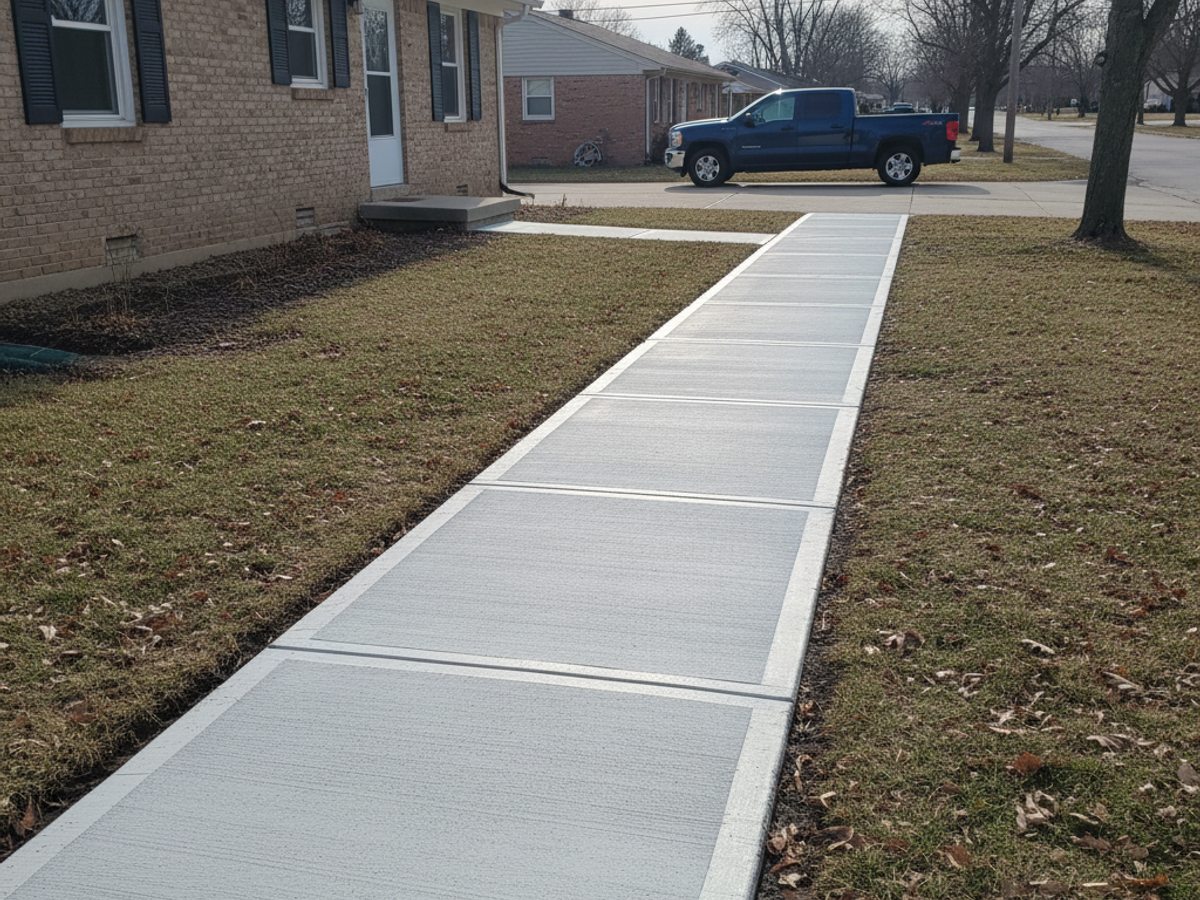
Every concrete job starts the same way everywhere: you dig, you pour, you finish. What's different in Elkhart is what's underneath that dig, and it's the reason a slab that holds up fine in one yard cracks or heaves in another three streets over.
I've poured on sandy ground near the St. Joseph River that drains almost as fast as you can wet it, and I've poured on dense clay till a half mile away that holds water for days. Same city, same crew, different soil, different result if you treat them the same.
What's actually under your yard
Most of Elkhart County sits on glacial till left behind from the last ice age, which in plain terms means a mix of clay, silt, sand, and gravel packed down over thousands of years. Close to the St. Joseph River and the Elkhart River, you often get sandier, looser soil that drains well but doesn't always compact to a solid bearing surface on its own. Move away from the river bottoms and you start hitting heavier clay, the kind that swells when it's wet and shrinks when it dries out. That swelling and shrinking is called expansive soil, and it's the single biggest reason concrete heaves, cracks, or settles unevenly here.
We don't guess which one we're dealing with. A few test holes down to 18-24 inches tell us whether we're working with clay that needs extra base material or sandy soil that's going to want extra compaction.
Frost depth and why the gravel base matters more than people think
Northern Indiana gets real winters. Elkhart typically sees somewhere around 30 to 40 freeze-thaw cycles between November and March, and the frost line here runs about 30 to 36 inches deep in a hard winter. That's why footings for anything load-bearing have to go below that depth, and it's also why a driveway or patio poured directly on native clay without a proper base is asking for trouble. Water trapped under a slab freezes, expands, and lifts the concrete. Thaw, refreeze, repeat a few dozen times a winter, and you get the heaving and the stair-step cracks people assume are just bad luck.
Our answer to that is boring but it works: 4 inches of compacted crushed stone under a standard slab, more if the soil test shows soft or saturated clay, graded so water has somewhere to go instead of sitting under the concrete. Skipping that step saves maybe an hour on a driveway pour. It costs a lot more than that to fix three winters later.
Where the water actually goes
Elkhart is flat enough in a lot of neighborhoods that grading does the real work of keeping water away from a slab, not luck. A lot of lots here were graded decades ago for surface drainage toward the street or a swale, and over time that grading settles, fills in, or gets changed by landscaping. Before we pour a patio or a driveway, we check which way water actually moves across that yard in a downpour, not which way the plans say it should move.
Low spots near the house, especially on older lots close to the river where the water table runs higher to begin with, need positive slope away from the foundation, usually a minimum of a quarter inch of fall per foot for the first several feet off the house. Get that wrong and you're not fixing a concrete problem next spring, you're fixing a wet basement.
Older neighborhoods versus new subdivisions
A lot of Elkhart's older housing stock, closer to downtown and along streets that grew up with the RV and manufacturing boom decades back, sits on lots that have been built on, dug up, and backfilled more than once. We've hit old foundation rubble, buried tree stumps, and inconsistent fill dirt on jobs in those older sections that you'd never expect from the surface. That changes how much excavation and base work a job actually needs, and it's part of why two driveways the same size can cost different amounts.
Newer subdivisions out in Osolo, Concord, and Baugo Township tend to have more consistent engineered fill from when the development went in, but the subsoil underneath that fill is still the same clay till the rest of the county has. New fill dirt doesn't change what's six feet down. It just means the top layer behaves more predictably during the pour.
Permits, inspections, and the setback question
Work inside Elkhart city limits goes through the city's building department, while projects out in the unincorporated county go through Elkhart County. For most residential concrete, that means a permit for anything structural like a slab foundation, and usually no permit needed for a standard patio or sidewalk replacement, though that varies by township and it's worth a phone call before you assume. Driveway work that touches the right-of-way near the street usually needs a separate approach permit. If your property is near a drainage easement or close to a lot line, we'll check setbacks before we pour, because moving a slab after it's cured is not a conversation anyone wants to have.
A lot of the newer subdivisions around Elkhart also have HOA rules around driveway material, color, or even whether stamped concrete is allowed, so that's worth checking on your end before you fall in love with a pattern.
What this actually means for your project
None of this is complicated once somebody explains it, but it's the difference between a slab that's still flat in ten years and one that's cracked by the second winter. Control joints cut within the first 24 hours so the slab cracks where you want it to instead of where it wants to. A base thickness matched to what's actually in the ground, not a standard number pulled from a spec sheet. Rebar instead of wire mesh on anything carrying real weight, like a garage floor, because mesh alone doesn't do much once soil underneath it shifts. Seven days minimum before you drive on a new driveway, closer to 28 days before it's at full strength.
We dig a test hole or two before we quote a job for exactly this reason, because what's under an Elkhart yard isn't the same from one street to the next. If you're planning a driveway, a patio, a garage floor, or any other concrete work on your property, Horizon Concrete can walk the site with you and tell you what the ground is going to ask of the job before you spend a dollar on it.