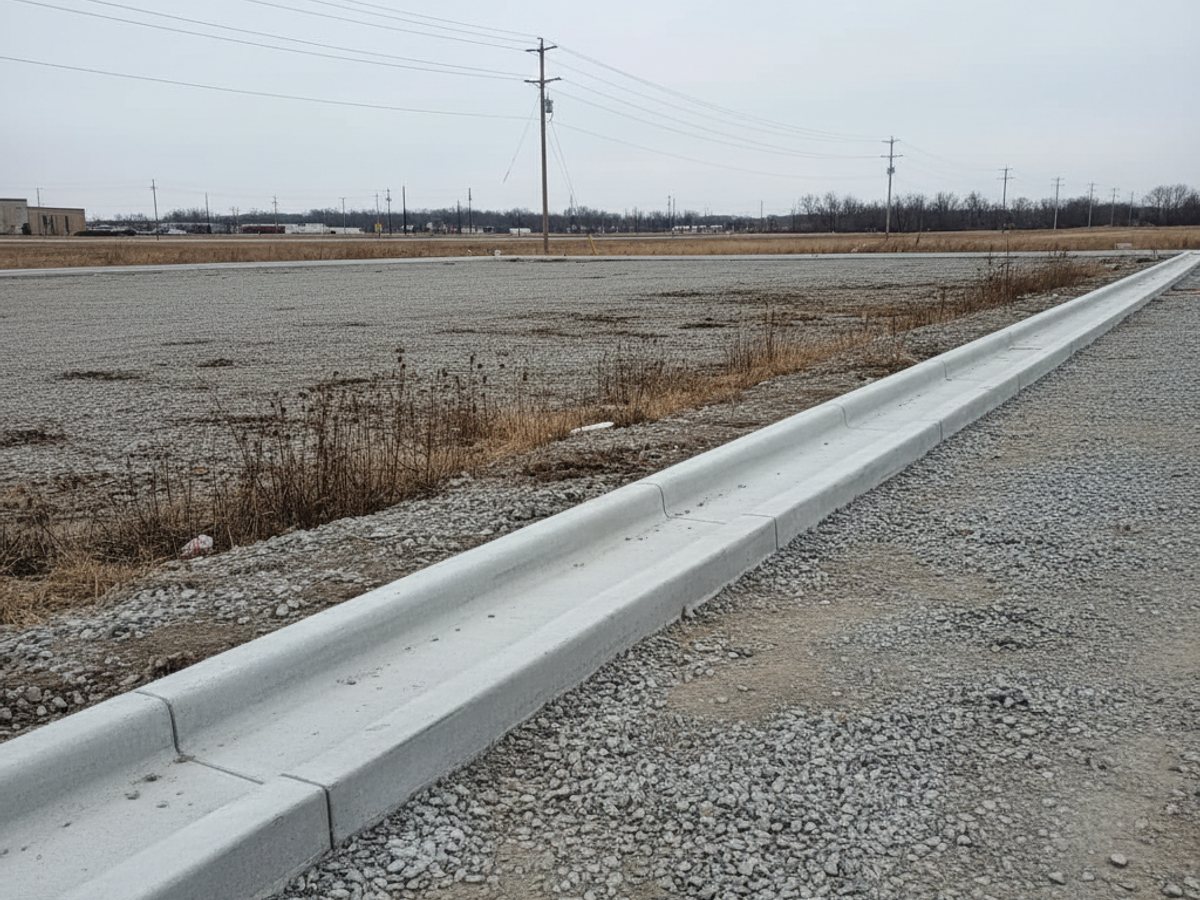
Most homeowners don't think about concrete until it's already cracked, heaved, or flaking, and by then they're calling three contractors and trying to guess who's telling the truth. There's no license test for "concrete contractor" in Indiana the way there is for electricians, so the range of skill you'll run into in Elkhart County runs from guys who've poured thousands of yards to guys with a mixer and a Facebook page. Here's how to tell the difference before you write a check.
Ask what's actually in the mix
A real bid names the thickness and the mix, not just square footage. A driveway that'll take daily car traffic should be 4 inches thick, minimum, and closer to 5 or 6 if it's seeing a truck or an RV parked on it regularly, which isn't rare around here. Ask for air-entrained concrete, usually 5 to 7 percent air content, because that's what keeps water inside the slab from expanding and blowing the surface apart when it freezes. Elkhart gets real freeze-thaw cycling, not just a few cold snaps, roughly November through March, and concrete without air entrainment will scale and flake within a couple winters. If a contractor doesn't bring this up unprompted, ask. If they don't know the air content of their mix, that's a red flag by itself.
Rebar versus wire mesh matters too, and this is where corners get cut. Mesh is cheaper and fine for a lot of patios, but it has to actually sit in the middle of the slab, not get walked into the mud during the pour, which is exactly what happens on rushed jobs. For driveways, garage floors, and anything carrying real weight, rebar tied on chairs gives you something to trust. Ask which one they're using and why.
What Elkhart's ground does to a slab
Most of this area sits on glacial till, a clay-heavy loam that doesn't drain fast. Close to the St. Joseph and Elkhart Rivers you'll hit sandier pockets that drain better but shift more under a footing. Clay soil holds water, swells when it's wet, and shrinks hard when it dries out in July and August. That movement is what pushes patios and walkways out of level and opens gaps at the house foundation. A contractor who knows the area will talk to you about compacting the sub-base properly, usually 4 inches of compacted gravel under a driveway or patio, before any concrete goes down. Skipping that step is the single biggest reason slabs settle unevenly two or three years later.
Grading matters just as much as the mix. Elkhart is flat enough that water doesn't move off a lot on its own, it needs help. A slab poured without at least a 1/8 inch per foot pitch away from the house will pond, and ponding water sitting against a foundation in clay soil is asking for basement seepage. Any contractor working here should be talking to you about where downspouts discharge and which way the driveway sheds water, not just how the concrete looks.
Permits, inspections, and who signs off
Inside Elkhart city limits, permits for driveways, sidewalks in the right-of-way, and slab foundations go through the city's building department, and a driveway apron that touches the street usually needs its own approval since it affects the public right-of-way. Outside the city, in the townships, it runs through Elkhart County instead. A slab foundation for an addition or a garage will typically get inspected before the pour, to check the footing depth and rebar placement, and sometimes again after. A patio or a sidewalk usually doesn't need the same scrutiny, but a driveway replacement that changes the grade or width often does. If you're in a newer subdivision, especially out toward Osolo Township or Bristol, check your HOA rules before you pick a stamp pattern or a border color, because some associations restrict exposed aggregate or colored concrete on driveways facing the street. A contractor who's worked here regularly will already know whether your job needs a permit. One who shrugs and says "you probably don't need one" without checking is guessing with your money.
What the bid should tell you, and what should worry you
A written bid should specify thickness, mix design or PSI rating (4,000 PSI is standard for driveways here, higher for anything with heavy vehicle traffic), the sub-base prep, control joint spacing, and a rough timeline including cure time before you can drive on it. Seven days is the usual minimum before regular car traffic, with full strength closer to 28 days, and that's worth knowing before someone tells you it's fine to park the truck on it the next afternoon.
Walk away from a contractor who won't put any of that in writing. Walk away from anyone who wants full payment up front in cash, or who's ready to pour tomorrow in the middle of a cold snap without mentioning blankets or a heated enclosure. Concrete poured below 40 degrees without protection can freeze before it cures and never reach its design strength, and that damage doesn't show up until the following winter when it starts spalling. Also be wary of a bid that's dramatically lower than the others with no explanation. Usually that means thinner concrete, no rebar, skipped sub-base compaction, or a mix without proper air entrainment, and you won't know which until it fails.
Look at their actual work, not just their website
Photos on a website tell you nothing about how a slab held up after three winters. Ask to see a driveway or patio they poured two or three years ago, not last month, and look at the control joints. They should be cut within about 24 to 48 hours of the pour, spaced roughly every 8 to 10 feet on a standard driveway, because that's how you tell the slab where to crack instead of letting it crack wherever it wants. If the joints are cut cleanly and the slab has held its color and level, that's a contractor who knows what they're doing on ground like ours. Ask for a couple of addresses in older Elkhart neighborhoods too, places built in the 1920s through the 1950s near downtown or Prairie Street, where the sub-base under existing walks is often uneven and old clay drain tile can be buried closer to the surface than you'd expect. A contractor who's dealt with that already won't be surprised by it on your property.
If you want a second opinion on a bid you've already got, or you're starting from scratch, Horizon Concrete can walk your lot with you before anything's decided.